Scientific research
Conduct atmospheric and scientific experiments in the near-space environment.

Take your ideas beyond Earth.
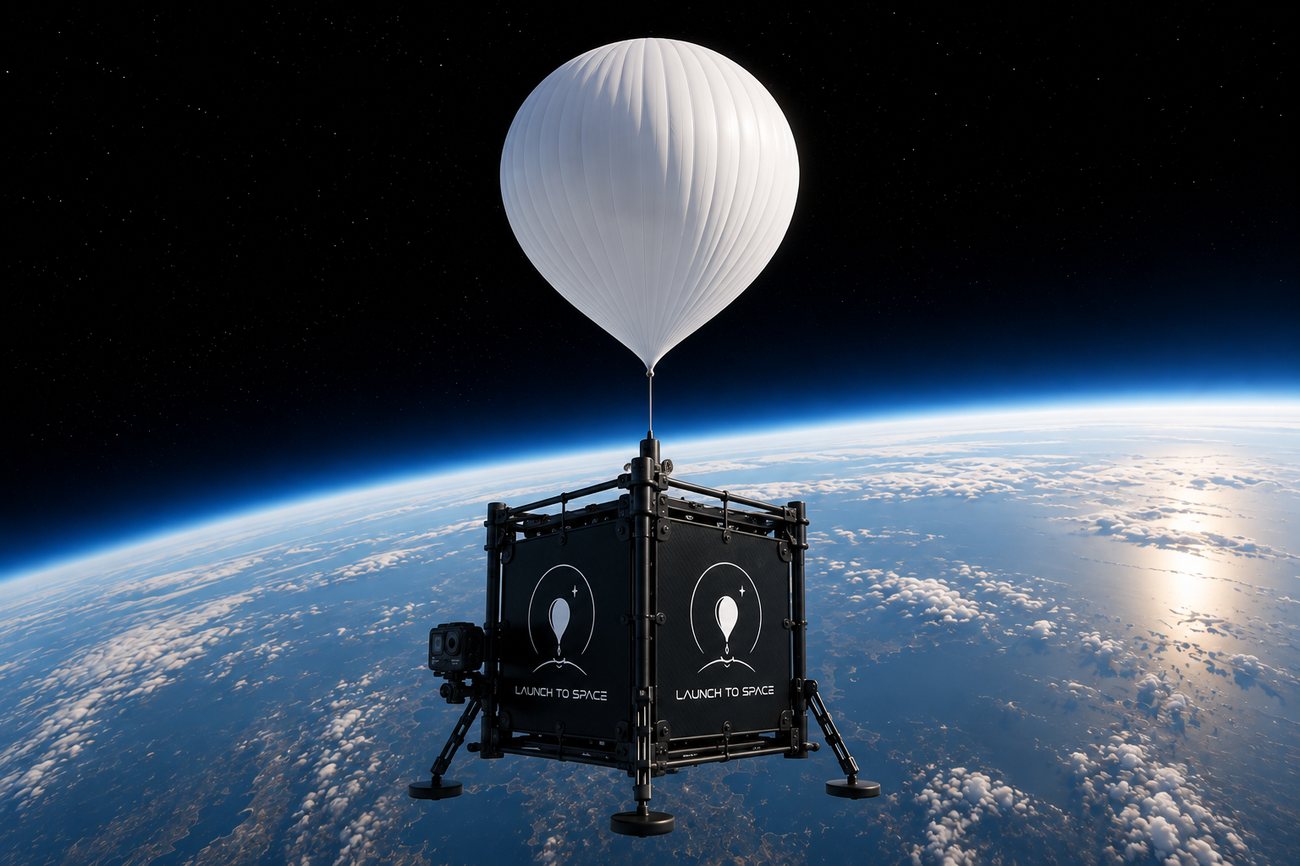
ToSpace's High-Altitude Balloon (HAB) platform carries ideas to the stratosphere for research, technology, education, commercial missions, and product marketing.
Altitude profile
Past the weather, past commercial air traffic, into the edge of space.
What Launch To Space enables
Every flight is a working mission – carrying instruments, cameras, prototypes, and products to near space, then bringing them back with the data and footage captured along the way.
Conduct atmospheric and scientific experiments in the near-space environment.
Test aerospace, electronics, communication and other technologies at high altitude.
Validate products and systems under near-space conditions.
Expose formulations, vaccines and biologics to near-space cold, low pressure and radiation.
Capture high-altitude photographs and video of your product and the Earth below.
Take your product to the stratosphere and build a campaign around the mission.
Associate your brand with aerospace, innovation, exploration and near-space technology.
Give students and institutions a real near-space mission to design, fly and analyse.
Customised high-altitude missions for companies and organisations.
Product marketing
Send your product or branded payload on a Launch To Space mission. We take it from Earth to the stratosphere and turn the mission into powerful content and a memorable brand experience.
Mission content
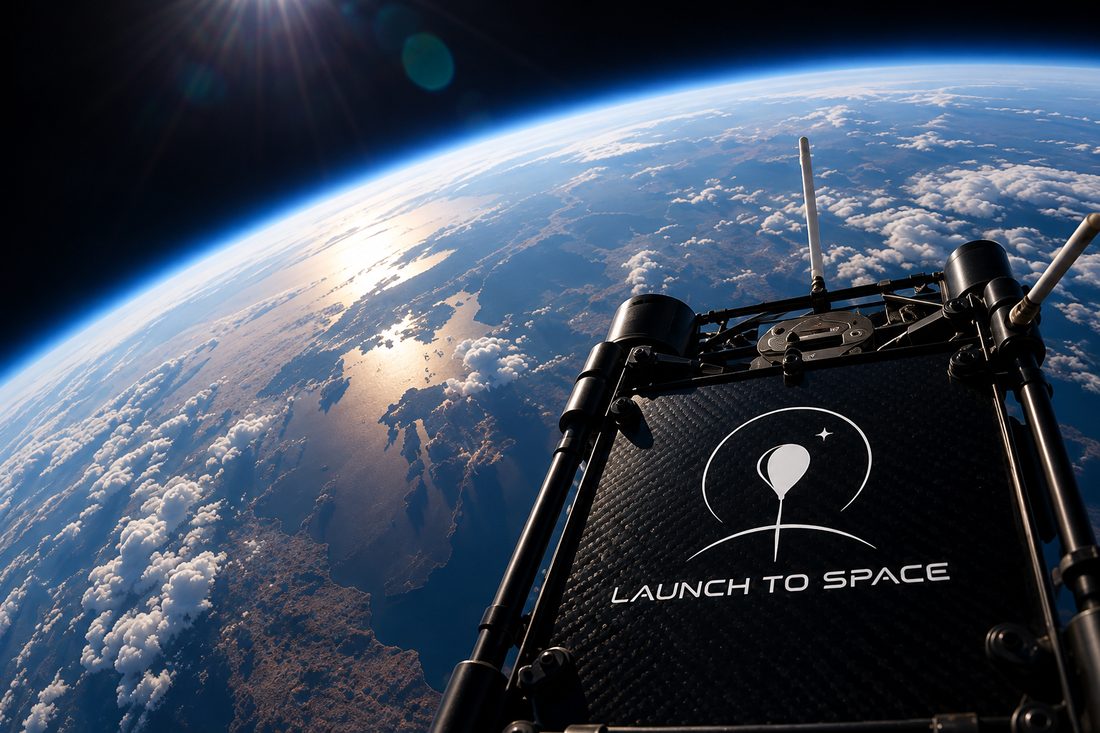
A flight is not only data. It is footage of your product against the black of space, a story with a date and an altitude attached, and a set of assets your team can use for a year.
Stills of your payload with Earth's curvature behind it.
Ascent, float and descent, cut for launch films and social.
Hero shots of your product in the stratosphere, not a studio.
Flight profile, altitude log, telemetry and a mission report.
Vertical cuts, stills and captions sized for every channel.
A press-ready narrative with imagery editors will actually run.
Our vision
Near Space, open to anyonewith an idea worth taking higher.
To make Near Space accessible not only for science and technology, but also for brands, products, creators, and people with ideas worth taking higher.
Launch To Space transforms high-altitude missions into experiences that people can see, share and remember, taking products, technology and ideas from Earth to the stratosphere.
Mission profile
Six stages, from the first call to the finished content. You are involved in all of them.
Define your mission and payload.
T − 6 weeksWe integrate and test your payload.
T − 2 weeksHigh-altitude balloon ascent to Near Space.
T − 0Collect data, images and video from the stratosphere.
T + 90 minSafely recover the payload.
T + 4 hrsReceive mission data and high-impact content for your brand.
T + 10 daysGallery
Clients & partners
Research groups, institutions and technology teams we work with on near-space missions.




About
Launch To Space is the High-Altitude Balloon platform built by ToSpace to make Near Space something you can actually reach, without waiting a decade or paying for a rocket.
A high-altitude balloon can carry a well-built payload to 30–35 km, hold it there while cameras capture the journey and instruments collect data, and bring it back the same day. From that altitude, you can see Earth's curvature, the darkness of space above the atmosphere, and how your hardware performs in an environment unlike anything on the ground.
We handle the full flight: balloon, carrier, tracking, recovery and mission operations.
You bring the idea. We'll take it beyond Earth.
FAQ
Launch To Space is ToSpace's High-Altitude Balloon platform. We fly payloads to the stratosphere, roughly 30–35 km, for research, technology demonstration, education, commercial missions and product marketing, and return them with data, imagery and video.
A standard mission reaches 30–35 km, well above 99% of the atmosphere. At that altitude the sky is black, the curvature of the Earth is clearly visible, and conditions approach those of space: near-vacuum pressure and temperatures around −60 °C. Actual altitude on the day varies with air currents and environmental conditions.
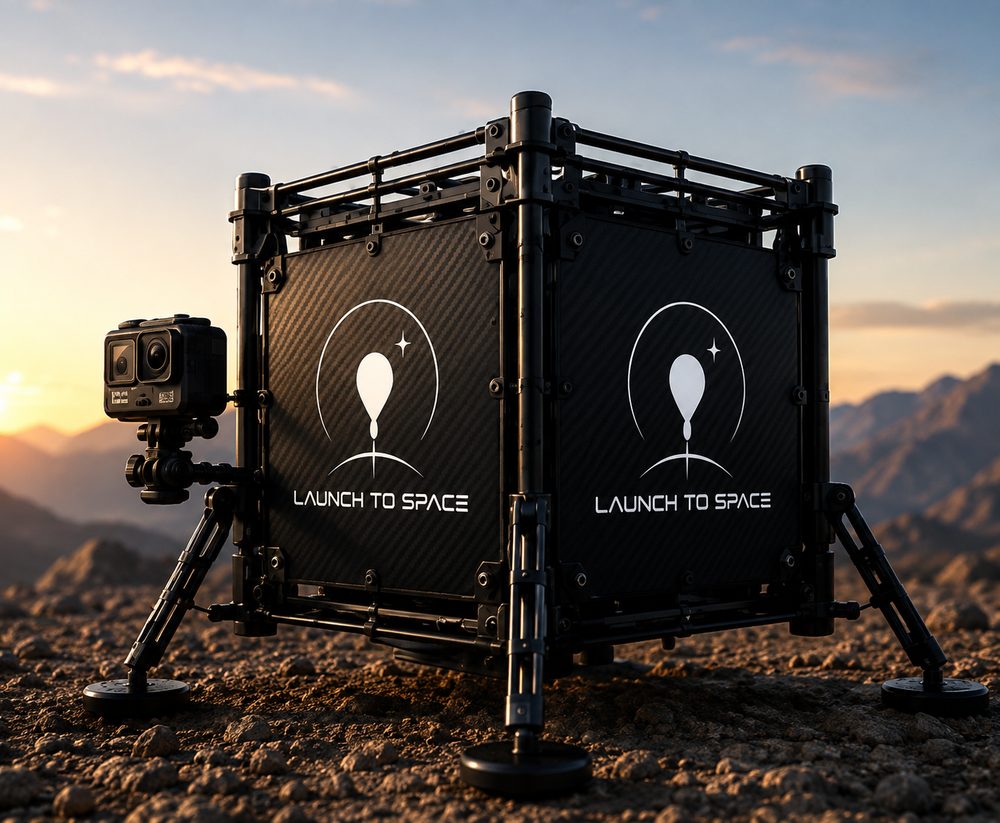
Whatever you want taken higher. Scientific instruments, cameras, sensors, electronics, technology demonstrators, student experiments, commercial products and branded payloads all fly on the standard carrier, with a baseline capacity of 2–5 kg. Sending a product is one of the most common missions we fly: we review the item for mass, size, materials and safety, design the mounting, and fly it with cameras framed on it. Larger or unusual payloads are assessed case by case.
That is what the platform is built for. You receive photography, video, product imagery and mission documentation, all cleared for commercial use in campaigns, PR, launches and social media.
Send us a short brief with what you want to fly, what you want back, and roughly when. Once we have your proposed launch location, we assess regulatory compliance and flight feasibility and respond within two working days with a mission plan, a payload checklist and a quote. From there, planning and payload integration typically take four to six weeks. The flight itself runs 2–4 hours from release to recovery, and edited content is delivered about ten days after landing.
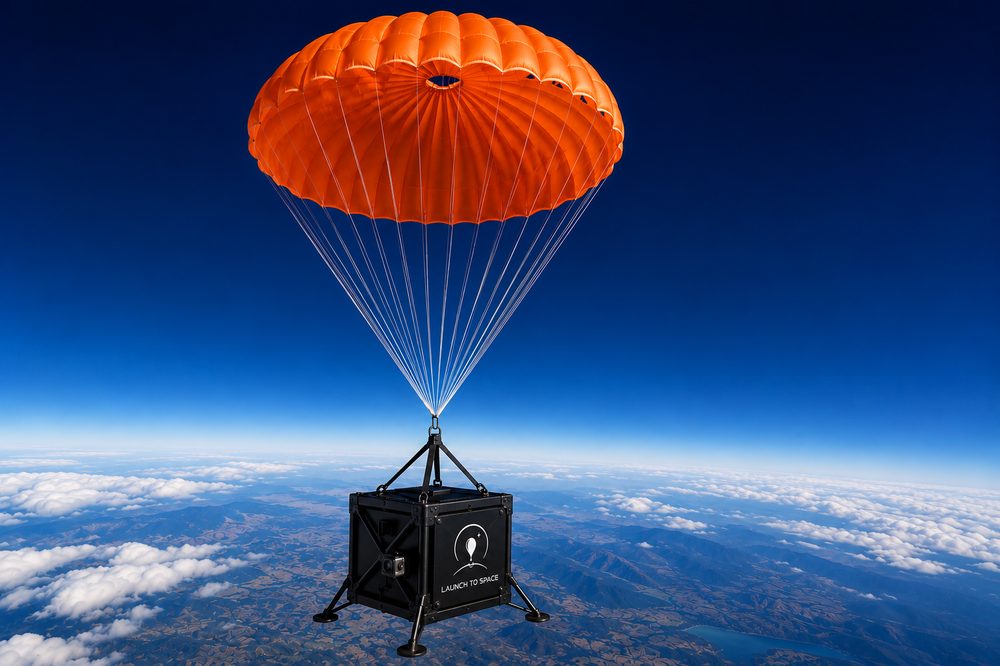
When the balloon bursts at peak altitude, a parachute deploys automatically and the carrier descends under canopy. Redundant onboard GPS transmits its position throughout and we monitor telemetry in real time, so a recovery team can collect it from the landing site the same day. In the rare event that a payload cannot be recovered, we fly a replacement mission at no additional launch cost, subject to the re-flight terms in our mission agreement.
Yes. We file for and obtain the required clearances from DGCA and the relevant local authorities for every launch, covering both the flight and your payload. You do not deal with the paperwork. Where a proposed site cannot be cleared, we identify a workable alternative with you before the mission is scheduled.
Every launch follows a strict Go / No-Go protocol on the day. We abort if weather conditions, adverse winds, rain or anything extreme, put a safe landing or the recovery team at risk. An aborted launch is rescheduled, not lost. If a proposed site does not clear regulatory or feasibility checks, we work with you to identify an alternative.
Potentially, yes. It depends on finding suitable launch and recovery sites and securing approval from local authorities; if both are viable we fly in your country. Otherwise we launch from India and courier your payload back to you, along with all video and data captured during the mission.
Both, and they are core to the platform. Schools, colleges and university teams design and build an experiment, take part in launch operations, and analyse their own flight data afterwards. For companies, carrier branding, camera angles, sensor suites, flight timing, launch site and the content package can all be tailored, and fully bespoke mission profiles are available for commercial programmes.
Mission consult
Choose a time to review payload fit, campaign goals, launch windows and the fastest path from idea to flight plan.
Contact
Bring us your idea, and let's take it higher.